'Who's providing all this money to the BJP? And who's providing all this money to the Congress?' 'Where did all this money come from?' 'Who is enabling all these MLAs to be bought for Rs 50, 60 crores?' 'There's one MLA on whose behalf somebody claimed that the BJP invited him for Rs 60 crores. Whose money is this?'
Successor Anandiben Patel isn't having an easy time, with a protest movement by her own community and new challenges in keeping the mandate
.jpg)
Investors often forget that the movements in indices such as the Sensex reflects the performance of its constituent stocks; nothing else.
Lack of visibility on rates makes companies apprehensive.

'As the interest rates rise, people are going to say why should I be taking big risks when I can get 4 to 5 per cent in a bank account.' 'So, I think you have to change your thinking.' 'You need to look at the balance sheet, look at dividends.' 'These issues that have been ignored.'

'If Modi arrived like a juggernaut, he left like a jigsaw puzzle whose pieces were being dismantled bit by bit. It was as if India had seceded quietly from him.' Shiv Viswanathan's social science fiction about what India would be like in 2020.

'This is a movie made with this gaze fixed on its immediate well-wishers, while at the same time it squints hard looking for those swaying back and forth on the fence,' notes Rohit Sathish Nair.

Banking is first about trust and integrity and then about technology and the rest.

Large manufacturers are investing in small companies to get a peek into their R&D. Alnoor Peermohamed and Anita Babu report.
'These children are wards of the State. They were exploited because the state government and its officials didn't do their jobs.'

Babajob.com is trying to help unorganised blue-collar workers get better employment.

Prime Minster Narendra Modi's op-ed in the German daily Frankfurter Allgemeines talks about development, New Age India and his 'Make in India' campaign. Here's the complete text of the column.

The upbeat earnings from Reliance Industries will set the tone for the truncated week ahead

Though not a blockbuster budget it does not undermine the fact that key issues were addressed and the finance minister certainly did not under-deliver, says Vatsal Srivastava.

Aiming to enhance quality of life while conserving the planet, Fourth Partner has ventured into the disruptive sector of solar power

The Narendra Modi-led National Democratic Alliance government, like its United Progressive Alliance predecessor, seems to be failing on suo motu disclosures under the Right to Information Act.

Today, Suzuki depends on Maruti for its place in the world

The impact of 'family first' on productivity in developing societies is yet to be modeled, says Agnikalam.
India needs to fix policy paralysis in order to reach teh top slot in solar power.

Tirole's insights show how real-world incentives are complicated, and contracts can be difficult to write and enforce.

Outlining eight "pillars" for the future of India-China relations, President Pranab Mukherjee on Wednesday underlined the need for comprehensively resolving challenges including the boundary question through "political acumen" and "civilisational wisdom".

Nitish Kumar has to eschew disastrous experiments with prohibition and reservations in the private sector. Unless he is dissuaded from pursuing these flawed measures, he will pave the way for Bihar to again become a part of the BIMARU group of sick states, says Amulya Ganguli.

Since the disastrous 2005 floods, that crippled Mumbai, little work has been done on disaster management and relief preparations.

These risks are viewed as more acute in the online world.

No country has achieved a faster, deeper modern transformation than China, says former ambassador Kishan S Rana.

In this industry, a company's strategy needs to be adaptable in order to keep up with the pace of change.

The population in Gaza has, for almost a decade, been facing Israel-created 'blockage' from the rest of the world. The isolation has given rise to tunnel phenomenon, an underground route for the procurement of essentials, says Ajey Lele
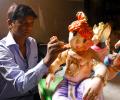
Sandeep Gajakosh wanted to be an artist, and God, he tells Tista Sengupta/Rediff.com, helped him find a way.

Instead of targeting global imbalances per se, the narrative must change to the structure and direction of such asymmetries.

Of the five towns planned, work is progressing in two, Dasve and Mogao.

'The darkest days of Indian democracy were (during) the Emergency when basic democratic rights were suspended. For a time it seemed as though India would move along the East Asian model -- everybody works hard, nobody asks questions, certainly not of the government.' 'There are people who say we are headed that way, but I am not persuaded by the evidence,' says Mahesh Rangarajan who recently resigned as director of the Nehru Memorial Museum and Library in New Delhi.

The party needs to fight competition not by acting like others, but by finding a strong narrative of its own.

Take a bow, Manish Malhotra!
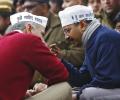
A party of newbies which had anger as fuel and hope in its own capability to work wonders suddenly finds itself not only in government but put on fast forward by everyone. These are heavy burdens for a fledgeling party, to perform under a microscope. Transparency is what they promised, and they are in a glass house now, says Mahesh Vijapurkar.

'Modi cannot content himself anymore with merely indulging in Congress bashing and referring to the Gujarat 'miracle'. He'll have to show that his party is as clean and as innovative as the AAP. And this is impossible because AAP is new and the BJP is now old: the people have tried it already. What they have not tried already is Modi, and this is what may make the difference,' says the respected political scientist Christophe Jaffrelot.

Though on the face of it appeared Pasbola was asking a series of odd questions that would be difficult for anyone to answer, there was, it gradually emerged, it seemed, a method to the questioning. Somehow, somewhere instinctively, Pasbola knew there was something not right with Riyaz's account.

States' demand of compensation from Centre for loss of tax revenue not on agenda.

Even as three Rafale fighters line up in Bengaluru for eye-popping aerobatics displays at the Aero India 2015 exhibition this week, senior ministry of defence sources say the proposal to buy the French fighter is "effectively dead".

Rajan also said it's a problem of collective action and not a problem of industrial nations or emerging markets
